
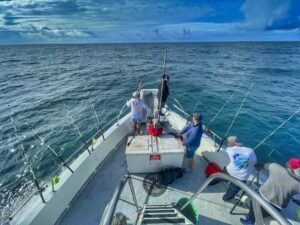
Deep sea fishing involves being on the open waters, generally so far away from the shore that you lose sight of it.
The majority of deep sea fishing activity occurs in waters that are over 100 feet deep, and the main targets are large species like tuna, sailfish, and marlin. Although the idea of catching these species is exciting, it requires a fair bit of effort on your part.
Also, as with all forms of fishing, there is no guarantee that you will even come across – let alone hook – your intended species.
Fortunately, a deep sea fishing trip is generally exciting, educational, and full of special memories whether you catch anything or not. Even better, there are several charters available worldwide that can help beginners in find their feet in the deep sea world.
In this blog, we have compiled a list of tips and tricks that we are confident you will find useful on your first deep sea fishing expedition.
Table of Contents
Deep Sea Fishing – Tips and Tricks
1) Choose a Boat with a Restroom
A deep sea fishing trip can last anywhere from 6 hours to 3 days, and being on a boat for that long has its limitations. You can significantly improve your deep sea fishing experience by booking a marine vehicle with a restroom.
It is best to be prepared for if and when nature calls – since the alternative can be rather uncomfortable.
2) Research your Charter Options
There are several types of charters, each offering a unique experience. Private charters, for instance, will accommodate your needs and provide a more individualized experience, but will also cost more.
On the other hand, shared or group charters are less expensive, and a good option if you are okay traveling with a bunch of strangers.
The truth is that deep sea fishing is costly – boats, licenses, gas, equipment, and maintenance do not come cheap. Hence, do not automatically believe that the cheapest charter company is also the best, since there is a fair chance it is cutting a few corners.
Before booking, go through the reviews for the company as well as for the captain and crew.
3) Prioritize Learning; Not Catching
Often, anglers kick off their deep sea fishing trip with a long list of unrealistic expectations.
Instead of being fixated on your catch, concentrate on learning to fish and do not let the adage ‘if you teach a man to fish…’ out of your mind.
There is no problem wanting to catch certain types of fish, but you must also remember that you are unlikely to materialize the entirety of that long wish-list.
Your skill level will largely determine what you catch or even if you catch anything at all, and that is what you should focus on building.
4) Weigh the Pros and Cons of Each Season
Generally, the best seasons for deep sea fishing are summer and spring. That said, do not overlook the off-season, especially if you are a first-time angler. You can still find numerous exotic catches from September to March. Besides, fewer boats translate to lesser competition.
If you have a particular species in mind, make sure to research its seasonal availability. Even if certain locations are known for certain types of fish, those fish may not be available all year round.
5) Pack Smart
Generally, charter boats provide a list of supplies you need to carry with you. Stick to that list, since it is designed to make the fishing experience as comfortable for you as possible.
Considering you will be out fishing for long hours, food and water should be among your topmost priorities. Other important items include clothing, medication, polarized sunglasses, sunscreen, and a camera.
Keep in mind that the weather cannot be trusted; things may be warm and sunny one minute, and start pouring down the next. Hence, remember to carry clothing that will keep you safe and comfortable in all kinds of conditions.
6) Have Clear Goals
When you book your charter, it’s crucial to let your captain know if you have any specific demands for fish species that you wish to target. Captains are intelligent folks who are familiar with both the sea and the land. They can match you up with anglers who share your interests and goals.
Mixed charter boat companies have to cater to all of their clients’ requests; the clearer and more realistic you are about your expectations, the easier it becomes for other people to join in on the action.
Create a simple list and do not be rigid in terms of target fish; certain species may have migrated and therefore may not be available during the ongoing season.
7) Prepare for Seasickness
If this is your first deep-sea fishing experience, or you have struggled with seasickness in the past, you need to be prepared for if it happens again.
If you are carrying OTC (over-the-counter) seasickness medicine, make sure to follow the instructions and take it at least an hour before you get on board. This gives the medicine enough time to enter your system and start working before your journey.
Also, remember to carry extra medicine in case you need a second or even third dosage – especially if you are going to be on the sea for more than five hours. It is always a smart idea to bring more medicine than you require and be able to help one of your companions should they need some.
Wrapping Up
Every deep sea fishing expedition is unique, which is one of the things that make it so thrilling. This is also why you should approach your expedition with an open mind. The more flexible your expectations about the fish you want to catch are, the less likely you are to set yourself up for disappointment.
Every trip is different: there will be days where everything will go smoothly, and there will be days where, despite your best efforts, you will not be able to achieve your fishing goals.
Regardless of how it goes, deep sea fishing is an experience you will not forget any time soon.