
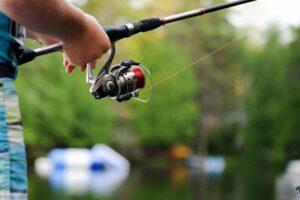
If you are a beginner angler ready to start their fishing journey, or a veteran who has not fished for some time, entering the doors of a large retail store can be quite intimidating.
There are countless options when it comes to fishing gear, and things can get very overwhelming very quickly.
While there are a number of different ways to approach fishing equipment, here is a list of the essential fishing gear you need for a successful angling experience.
Table of Contents
Essential Fishing Gear Checklist
1) Rods and Reels
Every fishing style has a specific set of rods and reels, but, as a beginner, it is best to keep things as simple as possible.
Make sure to look for rods and reels that can be used for both lure fishing and bait fishing. A medium-action, 8lb to 2lb line rated rod is an excellent option, allowing you to catch a wide variety of species commonly found in rivers and lakes.
First-time anglers should get used to spinning reels (also known as ‘open face’ reels) before moving on to bait-casting reels.
2) Tackle
As a first-time angler, you only need three kinds of tackle: floats, weights, and hooks.
Floats
Every angler out there began their fishing career with a float. Floats, also known as strike indicators or bobbers, help keep the bait off the lake’s bottom and offer a clear visual cue when a fish eats it.
Weights
Weights are required to extend the throwing range and keep the bait submerged. Novice anglers should stick with simple split-shot baits since these are inexpensive and fairly easy to install.
Hooks
Remember to avoid buying ‘snelled’ hooks. These types of hooks come with a pre-tied leader which is supposed to be attached to a swivel snap. We will talk more about hooks in a separate section.
3) Line
These days, fishing line is offered in a wide range of materials and sizes. In the same material, lines with a larger diameter are stronger than those with a smaller diameter.
Fluorocarbon lines are often abrasion resistant and virtually undetectable underwater, while braided lines are typically very strong and thin. Monofilament lines, meanwhile, are quite buoyant and stretchable.
Each of these line types has a particular application, but for now, keep things straightforward and stick to monofilament.
4) Live Bait
Most anglers (if not all) started their fishing journeys with live bait. The nightcrawler is possibly the most efficient, all-purpose live bait available. Almost all freshwater fish will consume nightcrawlers.
Live shiners make great bait for bass and other predatory species. Bass love these little bait-fish. To hook a live shiner, revert to the setup used for panfish, but remember to secure the bait to the bigger hook.
If you use shiners and your float goes underwater, you can pretty much rest assured that this was caused by a decent-sized fish.
5) Lures
You may eventually become bored of bait fishing and crave a fresh challenge –which is when you might want to experiment with lures. Although there are numerous lure colors, designs, and even manufactures, we will stick to the most popular lures that maximize the probability of success for first-time anglers.
Soft Plastics
When it comes to fishing bait, the Yamamoto Senko is one of the very best out there. This bait is particularly effective for Largemouth Bass found in rivers and lakes.
Regardless of the soft plastic bait you choose, make sure to practice with several depths and retrieve speeds to judge the position of the fish.
Top Water Lures
If the fish are nibbling at the surface, nothing compares to the joy of catching them with a top water lure.
The Whopper Plopper is among the most popular top water baits out there. It is fairly easy to use: all you need to do is cast the lure out, wait for the waters to calm down a bit after the lure has struck the surface, and start reeling.
Sometimes, you may need to alter the retrieve speed or add twitches or pauses.
One thing is for sure – if a fish strikes your top water lure, you will know.
6) Fish Finder
Imagine trying every lure and bait and still not being able to catch a thing. There may be a simple reason for this futility – there are no fish present.
Now imagine having the ability to see underwater and ascertaining that the water body does indeed contain fish. This is the precise ability that having a sonar device gives you.
Thanks to their low prices, easy usage, and high effectiveness, wireless fish finders are quickly becoming popular among newbie anglers.
7) Tackle Bag
Finally, you need a bag that can keep all the above equipment safe and organized.
Mobility is extremely important while fishing, since you may need to switch locations based on where the fish are. Hence, make sure your chosen bag is large enough to hold all these items and still comfortable enough to be carried around all day.
Fishing Tips for Beginners
1) Pick the Right Lure Colors
Match the color of your lure to that of the water.
Although you should always experiment with different colors when you’re not reeling in fish, as a general rule of thumb, begin by picking lures that match the color of the water.
You never know for sure what color lures the fish will favor on any particular day.
2) Choose the Best Time
Ideally, you should either fish at the start of the day or towards the end of it. Many fish species tend to bite best in natural sunshine at dawn and sunset.
Mid-day fishing may be slightly more challenging, since fish tend to seek out shade during these hot and sunny hours and resurface close to sunset. However, if there is decent cloud cover, you could give it a shot.
3) Keep it Cheap
Keep in mind that you don’t need to spend a fortune on fishing equipment. Fishing should be easy, fun, and inexpensive.
Keep in mind that around 90% of the fishing equipment on the market is designed to draw fishermen rather than fish. You do not need to take the bait.
4) Be as Prepared as Possible
When going fishing, expect the unexpected. You never know how the fish will behave, the lures they will be drawn to, and how the weather will shape up.
The more prepared you are, the more successful your expedition is likely to be.
Wrapping Up
As an angler, the most important pieces of gear are patience and persistence. Do not throw in the towel if you do not taste triumph in your first few trips.
Stay focused on building your skill set and, sooner or later, the fish will bite.