
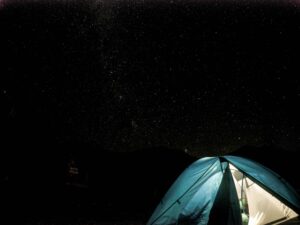
Spending a night in the great outdoors under a starry sky seems lovely – until you actually try to fall asleep at night. The noise of animals running through the woods, the uncomfortable, rocky, and hard ground beneath you, and the endless cycle of what-if scenarios prevailing in your mind can make it extremely challenging to sleep peacefully. Also, don’t forget about the lack of air conditioning or heat to help you get comfortable.
Despite all these problems, it sounds impossible to get a proper night’s sleep while camping. Continue reading to discover some of our top tips for sleeping while camping.
Table of Contents
1. Choose the Location Wisely
Your campsite is going to be your home during your camping trip, so just as you would for your permanent house, pick the location for pitching your tent smartly.
The ground where you pitch your tent needs to be dry, flat, soft, and shouldn’t have any stones. A layer of grass, pine straw, or leaves is great as it offers insulation along with welcomed padding.
Keep in mind that even the slightest include is going to pull your sleeping body to one side or make the blood flow through your head if you do not position yourself properly. Thus, remember to position your sleeping bag with your head uphill on a slope.
Lastly, don’t set up your camp close to a bathroom facility. There will surely be traffic during the night that might disturb you.
2. Invest in a Good Quality Sleeping Bag
All sleeping bags are not the same. If you plan to go on a multi-day camping trip, you cannot just go to the store and purchase the first sleeping bag that you ding. There are two key types of sleeping bags.
- Car Camping Sleeping Bag: These sleeping bags are wider and can usually be unzipped to convert into a blanket. They have more wiggle room, but they don’t do a good job of retaining heat. Thus, they are a better choice for people camping in a warmer location.
- Backpacking Sleeping Bags: Backpacking sleeping bags have a mummy shape, and their snug fit allows them to retain body heat. They generally weigh less than car camping sleeping bags and are easier to carry around. This makes them a great option for people who’ll be on the move and for people camping in a cool area.
Moreover, before purchasing a sleeping bag for your camping trip, check the online review to see what actual users have to say about it. Is it really as comfortable as the brand claims? How accurate is the temperature rating?
Ideally, you should purchase a bag with a cooler temperature rating than what the weather predicts for your trip. This way, you won’t be cold while sleeping.
3. Shut Out the External Noise
Howling winds and prowling animals are just a few sounds you might want to shut out while sleeping. Thus, when you are packing your camping supplies, make sure to keep earplugs for a sounder sleep at night.
If you don’t like to wear earplugs in bed, you can keep the bonfire tunes going after hours by keeping a portable Bluetooth speaker. You could play some relaxing music, white noise, or soothing sounds to put yourself to sleep.
In fact, recent research identified the most sleep-inducing melodies across numerous music genres. Thus, whether you prefer rock, hip-hop, or pop, there will surely be some music to help you sleep comfortably at night.
4. Get Some Exercise during the Day
There’s an extremely high chance you are going to exercise without even trying while camping. When you’re out in nature, you will be engaging in all types of physically stimulating activities that don’t feel like exercise.
A lot of campers are able to sleep better if they have swum, hiked, or done some form of physical activity that day. Thus, fill your day with active and fun experiences in the great outdoors, and you will be ready to sleep when the stars come out.
5. Say Goodbye to Bugs
Keep mosquitoes and other insects at bay by checking and mending any tears in your tent before your start your trip or pack extra mosquito netting. You can even use insect repellent sprays to keep them away from your tent and apply insect repelling lotion before sleeping to prevent turning into a midnight feast.
You can also keep pests and insects at bay by storing food properly and disposing of waste correctly. In fact, your campsite might have particular regulations for storing food and disposing of trash for safety reasons that you need to adhere to. Storing food in your tent or wearing clothes with food residue when going to sleep can be dangerous.
6. Keep Yourself Warm
Adding an insulating layer between the cold ground and your sleeping bag is crucial to keeping yourself warm at night. Even when you have a large air mattress, you can create an insulation layer between the cold ground and the air inside your mattress by using a closed-cell foam pad.
The extra padding is also going to add a comfortable layer to protect your joints and muscles after a whole day of mountain climbing, rafting, and hiking.
Also, when it gets extremely cold, you can boil water, pour it into a hot water bottle, and throw it in your sleeping bag before going to bed. When the temperature drops, this technique can be a total game-changer!
7. Don’t Forget to Pack Your Pillow
Some people think they can just bundle up their clothes and call it a pillow. However, having a camping pillow adds a degree of comfort that is totally worth it! This is particularly true if you are RV camping and space is not a problem.
Last Few Words
Sleeping in a tent while camping can be a lot of fun. However, sleep can be elusive if the conditions aren’t right. You might take some time to adjust to your life in a tent and need some trial and error to find out what works for you. Don’t give up on your camping experience – just follow the tips for sleeping while camping we have outlined above and you will be good to go!