

Stargazing is an activity that involves observing the stars and other elements in space either as a hobby or as a part of astrology and scientific studies. Stargazing is readily being pursued as a form of mindful meditation during an era of immense chaos. While you may reconnect with nature and yourself in a solitary escapade, sharing the celestial awe with others is just as desirable.
Table of Contents
The Basics for Stargazing
Contrary to popular belief that stargazing is an expensive hobby, all you need to get started on is a pair of eyes and a sky map to discover the constellations. If your interest in stargazing develops further, you can invest in binoculars as a beginner rather than a telescope. They tend to offer a right-side-up view and are easy to aim. Since most individual stars are located inside the galaxy, you don’t need any advanced equipment to view the sky.
Telescopes are for experienced astronomers who can study the mirror-reversed or upside-down view of the sky through the lens. Moreover, the telescope has an array of tiny fields, which makes it tedious to aim it precisely. However, the telescope does offer a clearer picture of the planets, stars, and constellations within our galaxy.
The Mental Health Benefits of Camping Under the Stars
Reconnecting with nature now and then is vital for the soul. Stargazing is a calming and grounding experience that benefits the stargazer psychologically and emotionally. A recent study found that 95 percent of campers improved their mental health well-being by existing in an all-natural surrounding for five to six hours a week — just about the time you need when camping under the stars.
In addition, the sense of awe that’s felt when glaring at the night sky is known to increase kindness, concern, and generosity for others. It also improves creative thinking and empathy.

How to Stargaze
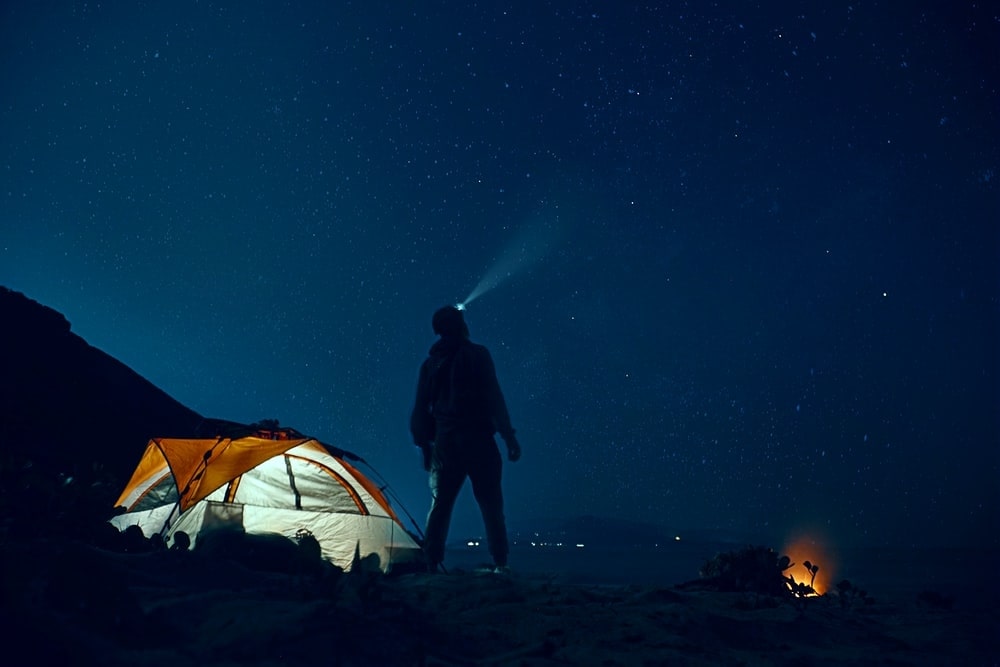
Camping under the stars can be a magical experience, given that you came prepared to spend the night out. Your camp should be located in a quiet, dark place, far away from other campsites that may distort your view of the sky. You want to wear warm clothes because nights like these tend to get cold and windy! But most importantly, you need to bring the right supplies for stargazing — for example, a star chart to help you analyze the phases of the stars and the moon or a pair of binoculars to help you spot planets and stars clusters located farther away. Don’t forget to bring cellophane to cover your flashlight if you want to see some of the dimmer constellations when stargazing.
Now for the difficult part — the things you need to study in the night sky.
- Starting with the moon, it undergoes eight phases while making a complete rotation around the earth. What phase could it be tonight — new moon, waxing crescent, first quarter, waxing gibbous, full moon, waning gibbous, third quarter, or waning crescent?
- Over time, stars tend to change color and temperature due to scintillation — i.e., refraction of starlight as the air moves in and out through the Earth’s atmosphere. So, which of the stars are red and which of them are white tonight?
- Spot the Milky Way made of a million distant stars — it appears as a faint cloud that can’t be viewed from 80 percent of the locations due to light pollution. Note: the galaxy is best seen during summer or fall.
- The easiest constellation to find in an open sky is the Big Dipper — find it through its cup and handle formation. If you’re lucky, you should also be able to spot the North Star that has helped sailors to navigate the seas for centuries.
How to Camp Under the Stars
Did you know that your senses tend to engage differently during the night than during the day? You should be able to smell all the plants individually and hear nocturnal animals around your campsite. As for your eyesight, you may need to give your eyes a few minutes to adapt to the darkened surroundings, after which you should be able to witness newer images and unexpected patterns emerging under the moonlight.
As mentioned earlier, a pair of binoculars should help you witness the magic of the night sky up close and personal — but if you find yourself bit by the stargazing bug, there’s no other way for you to go other than investing in a telescope. To further improve your stargazing experience, you may do the following:
Download a Stargazing Application
Use a stargazing application to identify all the things you’re looking at in the night sky. When you point your smartphone towards the sky, the astronomy app will automatically display labels for constellations, planets, and stars to help you differentiate one from the other.
Familiarize Yourself with Astrophotography
There’s no harm in trying your luck with photography when camping under the stars. Astrophotography is the photographic study of the night sky that allows you to capture the most stunning views!

Explore the World with Outdoor Viewer
As Eric Overby stated in his book, Legacy, “You know that all I have is all that we are — so hold me close tonight, underneath a billion stars.”
Outdoor Viewer was established in 2019 to offer its audience insights about fishing, hunting, camping, and hiking. Here you will find product reviews for outdoor equipment that will assist you in all that you should buy. Find relevant categories: fishing products reviews, product reviews for hunting gear, reviews on tents for camping, and best camping gear for the hiking trip.