
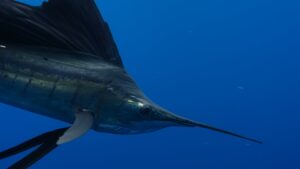
There are many different types of game swimming our waters. While some of them are easier to catch, others can give even the most seasoned anglers a run for their money.
These tough fighters are not necessarily the largest fish in the ocean, but they do have some overwhelming trait that makes them tough to catch. It could be their lightning-fast speed, their surprising strength, or the reserves of stamina that never seem to run out. Perhaps they are incredibly hard to lure into biting your bait.
The point is, hardcore fish can be found in a range of flavors and below is a list of the fish that we believe deserve the most recognition in this regard.
Table of Contents
7 Hardest Fish to Catch
1) Blue Marlin
Equal parts challenging and majestic, both the Pacific Blue and Atlantic Marlin can live up to 27 years, and grow to be more than 14 feet long and 1,500 pounds heavy.
Blue Marlins are quite migratory and tend to chase the warm currents in the Indian, Pacific, and Atlantic oceans for thousands of miles each year. They prey on a wide range of species, including bonito, dolphin, wahoo, and various mackerel and tuna species.
Dead baits are usually most effective in capturing Blue Marlins, but lures (or a combination of lures and baits) can also work quite well. Capable leapers and high-speed divers, Blue Marlins put their impressive power to work the second they sense the hook. Unsurprisingly, they are a precious prize for anglers from all across the globe.
2) Tarpon
Tarpons are best known for their agility and acrobatic skills, capable of leaping as high as 12 feet in the air.
This means that, even if you manage to hook a tarpon, be prepared to face a great deal of resistance and pain.
Also, we strongly recommend hooking tarpons at night and with live mullet as bait. This will make you slightly more attractive to them and you will also have to deal with fewer challenges out in the sea.
3) Swordfish
Found in tropical and temperate ocean waters globally, swordfish are usually migratory but prefer travelling alone. Furthermore, despite being regarded as a deep-water game fish, you can also find swordfishes relaxing on the water surface with their tail and dorsal fins exposed.
This fish uses its large bill to defend itself and to stun or kill prey like dolphin, bonito, mackerel, as well as a number of other pelagic fishes.
We recommend hunting for swordfish at night, using drifting deep baits like rigged bonito, mackerel, squid, or large mullet, lit by cyalume sticks or small strobes.
Swordfish are finicky creatures and can be easily startled, which is why you need to present the bait slowly and repeatedly. Other than that, they have soft mouths which make solid hookups a bigger challenge.
4) Giant Trevally
As the name suggests, the Giant Trevally is quite gigantic. There are close to 30 trevally species, but none larger or stronger than the Giant Trevally.
The Giant Trevally, also referred to as ‘GT’, is known for its excessive resilience and stamina. It will never go down without a fight, and may even enter your boat if you haven’t lured it in yet.
The GT certainly does not make life easy for anglers. Tough and stubborn, it is not going to bow down to you and simply succumb to your desires or demands.
5) Stripped Marlin
This species of marlin, which lives in the warm, tropical seas of the Indian and Pacific oceans, is well known for its thrilling airborne displays.
Since it frequently stays in packs, the possibility of double and treble hookups makes the Stripped Marlin even more tempting.
Even though Stripped Marlins prefer feeding on mackerel, anchovies, squid, sauries, and flying fish, they are rather opportunistic foragers who find it hard to refuse an easy meal. This makes the species an excellent candidate for a variety of angling strategies, including trolling natural lures and baits and bait-and-switching.
6) Bonefish
The bonefish is so-called because of the numerous little bones in its body.
The large number of bones means that bonefish are generally difficult to each, which is why many anglers prefer to see bonefish fishing as a catch-and-release exercise. That said, Hawaiian people are quite fond and regular bonefish consumers.
The species is a tough nut to crack, not least because of its highly effective camouflage that allows it to stay largely incognito in the water. Other than that, their blistering speed, stunning strength, and highly suspicious nature just adds to the challenge they present.
Live shrimp is often considered the best bait for bonefish, but conch, crab, and cut shrimp are also effective. As far as lures go, the best one is ‘cut’ jigs (1/8 or 1/4 ounce), with horizontally flat heads that allow the hook to stay upright.
7) Permit
There are few fish that have been as frustrating for anglers as Permits. This is because this fish is highly sensitive to vibration and movement. They possess large eyes and considerably more sensitivity than almost any other inshore species. They are very cautious of any unnatural movements or sights. Even if you do manage to hook a Permit, it will fight like a man possessed.
But, this is also why catching a Permit comes with bragging rights, and the reason that anglers and fishers refuse to concede defeat.
Permits usually feast on crustaceans like shrimp, pass crabs, and blue crabs. For this reason, you must choose your lures and baits carefully. Live baits like jumbo-sized shrimps and silver crabs are ideal. Other than that, crab chunks and even lobsters can work with naturally-colored jig heads.
Wrapping Up
To sum up, trying to catch the above game can be a tough, challenging, and even dangerous business.
But that is also the reason that capturing these species brings a lasting sense of achievement for anglers while also allowing them to experiment with new strategies and polish their fishing skills.